

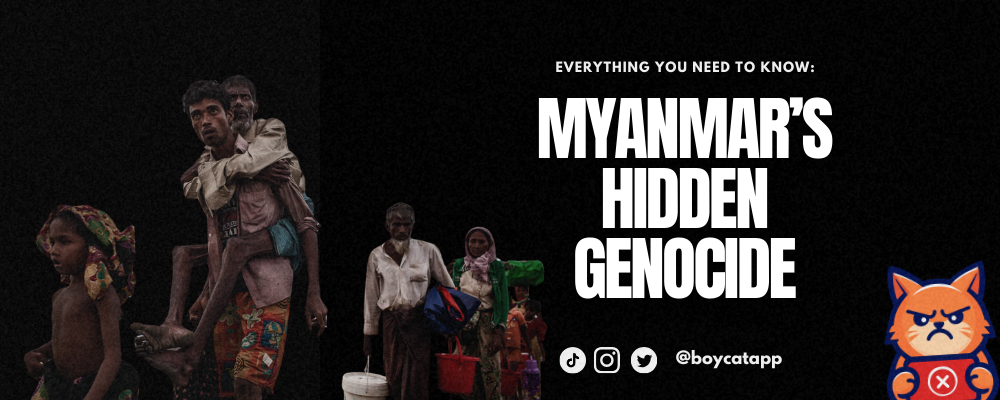
Myanmar’s crisis has two truths at the same time:
- The Myanmar military committed genocide and ethnic cleansing against the Muslim Rohingya, especially during the 2016–2017 crackdown that forced 700,000+ people into Bangladesh in 2017 alone.
- After the February 1, 2021 coup, the same military expanded mass violence nationwide, including airstrikes on civilians and widespread war crimes against many communities, including Karen, Kachin, Shan, Chin, and others.
If you only talk about the Rohingya, you accidentally imply everyone else is fine. That is not true.
If you only talk about the coup-era war, you erase a genocide.
This explainer covers the full picture in plain language.
At a glance
Rohingya genocide and ethnic cleansing
- 2016–2017: Military “clearance operations” escalated into mass atrocities in Rakhine State.
- 2017: 700,000+ Rohingya fled to Bangladesh, and hundreds of villages were burned. (Commonly reported as 400+ villages in rights reporting and investigations.)
- Today: Bangladesh hosts over a million Rohingya refugees in and around Cox’s Bazar, with ongoing risks from funding cuts and insecurity.
Nationwide atrocities after the 2021 coup
- Civilians killed: UN reporting citing AAPP places the death toll at 6,231 civilians killed by the military over the first four years after the coup.
- Displaced: UN humanitarian updates estimate around 3.5 million people displaced.
- How: Retaliatory airstrikes, artillery shelling, arbitrary detention, torture, and aid blockades.
International justice
- ICJ: The International Court of Justice ordered Myanmar to prevent genocidal acts and preserve evidence (provisional measures, January 2020).
- ICC: In November 2024, the ICC prosecutor requested an arrest warrant for junta chief Min Aung Hlaing for crimes against humanity linked to Rohingya deportation and persecution.
Who are the Rohingya, and why were they targeted?
The Rohingya are a Muslim ethnic minority from Myanmar’s Rakhine State.
For decades, they have been pushed out of citizenship and basic rights. A key turning point was the 1982 citizenship law, which effectively made many Rohingya stateless, leaving people without normal protections like freedom of movement, access to education, and equal treatment.
Statelessness is not just paperwork. It is the doorway to persecution.
When a state decides a community is “not real,” it becomes easier to deny them safety, then deny them dignity, then deny them life.
What happened in 2016–2017?
In late 2016 and then again in 2017, violence escalated sharply in northern Rakhine.
After attacks on security posts by Rohingya militants, the military launched what it called “clearance operations.” Multiple investigations and survivor accounts describe a consistent pattern:
- villages surrounded
- homes burned
- mass killings
- rape and sexual violence
- people shot while fleeing
- entire communities erased
A widely repeated survivor testimony captures the horror:
“They burned down our houses, raped our mothers and sisters, burned our children.”
The outcome was one of the fastest refugee exoduses in modern history.
More than 700,000 Rohingya fled into Bangladesh in 2017 alone, joining earlier waves of refugees and forming the largest refugee settlement on earth around Cox’s Bazar.
The United Nations described the campaign as ethnic cleansing, and many human rights experts and investigators argue the evidence meets the legal threshold for genocide.
What life looks like now for Rohingya families
In Bangladesh:
Rohingya families live in dense camps with limited mobility, limited work options, and constant uncertainty. UN agencies warn that funding shortfalls can trigger ration cuts and make families more vulnerable to exploitation or dangerous sea journeys.
Inside Myanmar:
Large numbers of Rohingya remain trapped under severe restrictions. Human rights organizations have described these conditions as a form of apartheid-like control in practice, where movement, education, and health access are restricted by policy and enforcement.
The 2021 coup turned the whole country into a battlefield
On February 1, 2021, the Myanmar military seized power. Protests erupted. The response was violent.
Over time, the crisis expanded into a nationwide conflict affecting many communities, especially in ethnic states and resistance strongholds.
A UN human rights analysis of 2024 found that as the military’s grip weakened, it launched “wave after wave” of retaliatory airstrikes and artillery attacks on civilians and civilian-populated areas, while also restricting humanitarian access.
A UN report in September 2024 stated:
- At least 5,350 civilians killed
- More than 3.3 million displaced
- Nearly 27,400 arrested
since the coup.
Later UN updates cite displacement rising to around 3.5 million.
This violence hits many groups, including Karen, Kachin, Shan, Chin, and others. That is why any serious explainer has to hold both truths at once: Rohingya genocide and nationwide war.
What abuses are being reported?
Across different regions, the recurring patterns look like this:
1) Airstrikes and artillery on civilian areas
Villages and civilian sites are repeatedly hit.
A UN report describes escalations in airstrikes and shelling, including child casualties.
2) Arbitrary detention and torture
UN reporting describes pervasive torture and deaths in custody, including shocking interrogation methods.
3) Forced conscription and coercion
UN reporting highlights forced recruitment and young people fleeing to avoid being forced into military service.
4) Aid blockades
Humanitarian access is restricted, including during disasters, making hunger and disease risks worse.
5) The fuel behind the air war
Amnesty has reported that the military uses covert supply tactics, including “ghost ships,” to import aviation fuel used in air attacks, and urged a ban on aviation fuel shipments into Myanmar.
What has the world done?
The ICJ genocide case
The International Court of Justice ordered Myanmar to prevent genocidal acts and preserve evidence as the case proceeds. This is the highest UN court.
The ICC move against Min Aung Hlaing
Myanmar is not an ICC member, but because parts of the Rohingya deportation occurred across a border into Bangladesh (an ICC member), the ICC has jurisdiction over key aspects of the crime.
In November 2024, the ICC prosecutor requested an arrest warrant for junta chief Min Aung Hlaing for crimes against humanity tied to Rohingya deportation and persecution.
Important wording: a prosecutor “requesting” a warrant is not the same thing as judges “issuing” a warrant. This is still a major step, but accuracy matters.
Follow the money: how the military funds itself
Myanmar’s military is not only a fighting force. It is also a business empire.
Two military holding companies are especially central:
- Myanmar Economic Holdings Limited (MEHL)
- Myanmar Economic Corporation (MEC)
The US Treasury describes MEHL and MEC as military-controlled conglomerates with business interests across major parts of the economy, and sanctioned them in 2021.
A second major revenue channel is oil and gas:
- Myanma Oil and Gas Enterprise (MOGE)
The US Treasury said MOGE is a key source of foreign revenue and moved to prohibit certain financial services benefiting MOGE, alongside coordinated actions with the UK and Canada.
Companies and entities to avoid
Boycat’s approach is simple: do not fund systems of oppression if you can avoid it.
These are high-signal entities repeatedly tied to military revenue:
Highest priority avoid list
- MEHL (Myanmar Economic Holdings Limited)
Military conglomerate sanctioned by the US and EU. - MEC (Myanmar Economic Corporation)
Military conglomerate sanctioned by the US and EU. - MOGE (Myanma Oil and Gas Enterprise)
Major state enterprise and revenue source linked to the junta’s finances.
Watch list: military-linked telecom revenue
- Mytel (military-linked telecom)
Widely reported as a joint venture involving the military-linked MEC and Vietnam’s Viettel.
Practical note: Many “brands to avoid” are not simple consumer labels. Often, the real issue is ownership and revenue flow. That is why Boycat focuses on mapping corporate ties.
What you can do today
1) Share the full story, not half of it
Say both clearly:
- The Rohingya genocide is real.
- The nationwide war is real.
2) Support credible relief efforts
Look for reputable humanitarian organizations working with displaced communities in Myanmar and Rohingya refugees in Bangladesh.
3) Pressure governments for action that actually matters
- aviation fuel restrictions and enforcement
- targeted sanctions against military revenue channels
- accountability pathways that preserve evidence and pursue prosecutions
4) Use your spending as pressure
Do not normalize doing business with military revenue structures.
Boycat campaign launch: Myanmar
Today, we are launching the Myanmar campaign inside the Boycat app.
Inside the campaign, you will be able to:
- see the key military-linked entities to avoid (MEHL, MEC, MOGE, and connected networks)
- understand why they matter in one-screen summaries
- stay updated on sanctions, accountability moves, and major developments
- find safer alternatives where possible
The goal is not performative outrage. The goal is clarity, then action.
Because silence is what genocides depend on.