

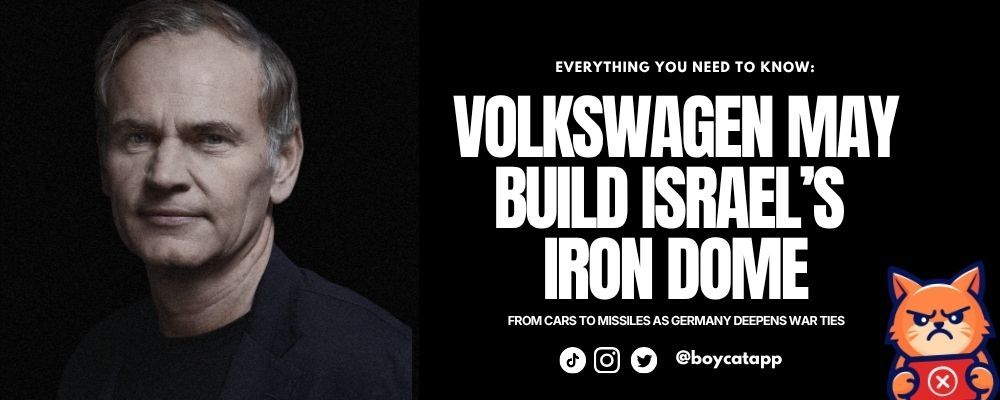
A shift into weapons production with a history that raises questions
Volkswagen is in discussions to manufacture components for Israel’s Iron Dome missile defense system, according to reporting cited by Middle East Eye.
The talks involve Israel’s Rafael Advanced Defense Systems and would see the company repurpose its Osnabrück plant in Germany. The site, currently used for car production, could be converted into a facility producing equipment linked to Israel’s air defense infrastructure.
What the plan includes
Under the proposal, the factory would manufacture:
- Launch platforms
- Power units
- Heavy-duty vehicles used to transport missile systems
Production could begin within 12 to 18 months and would require limited new investment.
The shift would place Volkswagen inside the supply chain of a system actively used in Israel’s ongoing military operations.
Why Volkswagen is considering it
Germany’s automotive sector is under pressure. Chinese electric vehicle manufacturers are taking market share, and several plants face an uncertain future.
The Osnabrück site is one of them. Repurposing it for defense production is being presented as a way to preserve jobs and keep the factory operational.
One person familiar with the discussions said the goal is to secure employment at the plant:
“The aim is to save everybody, maybe even to grow.”
Germany’s expanding defense ties with Israel
Germany is already one of Israel’s largest weapons suppliers, accounting for roughly 30 percent of its imported arms.
Berlin has approved multiple large-scale defense deals in recent years, including a $3.1 billion agreement for the Arrow 3 missile defense system. Combined with earlier contracts, total agreements exceed $6.6 billion.
These partnerships have continued during Israel’s war on Gaza.
The historical weight
Volkswagen’s involvement in weapons production is not without precedent.
During World War II, the company halted civilian manufacturing and produced military equipment for Nazi Germany.
That history has shaped how the company is viewed globally. Any return to defense manufacturing, particularly in the context of an active conflict, brings that legacy back into focus.
Local reaction in Germany
The reported plans have drawn concern from workers and residents in Osnabrück.
Some have questioned whether shifting to weapons production is the right response to economic pressure.
“Producing war materials could lead to developments akin to those that may trigger World War 3 instead of securing employment,” one worker said.
A local resident added:
“The German government is complicit in this and I am against this and don’t want such a thing.”
What this signals
The discussions highlight a broader shift taking place across Europe.
Industrial capacity that was once dedicated to consumer goods is increasingly being redirected toward defense. Governments are supporting the transition, and companies facing economic pressure are responding.
For Volkswagen, the decision is not only about maintaining production at a struggling plant. It is about whether to enter a military supply chain linked to an ongoing conflict that is already under international legal scrutiny.
The decision ahead
Volkswagen has not confirmed any final agreement.
If the plan moves forward, the company would move beyond its role as a consumer manufacturer and into direct participation in defense production.
Given its history, that shift carries consequences that extend beyond business.
Support Boycat
Most people cannot control the security architecture used by companies they interact with online. But they can take steps to protect their own internet activity.
This is where privacy tools such as BuycatVPN become important.
BuycatVPN helps users:
- encrypt their internet traffic
- protect browsing activity from tracking
- secure connections on public networks
- reduce visibility into personal browsing behavior
Download BuycatVPN: