

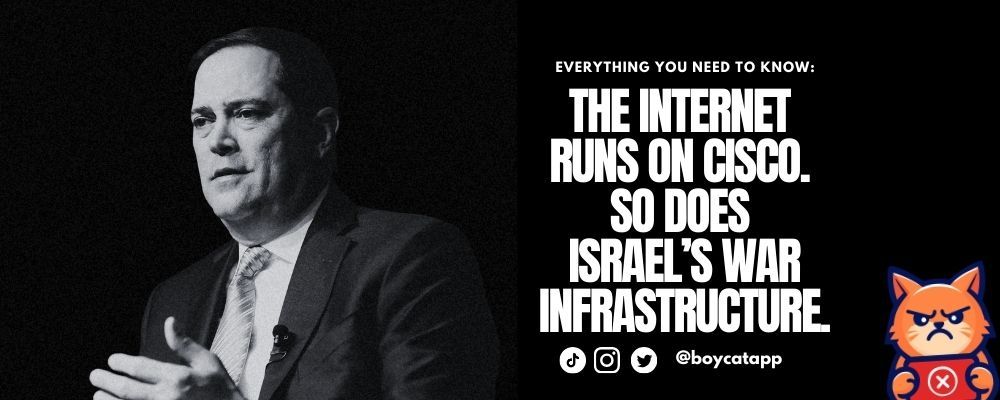
Most people have never thought about Cisco.
But if you search online for “boycott Cisco”, “Cisco Israel”, or “Cisco Palestine,” you will quickly find a growing controversy surrounding the company.
Cisco, one of the largest internet infrastructure companies in the world, has been accused by human rights researchers and activists of providing technology used in Israeli military networks, surveillance systems in Jerusalem, and data infrastructure connected to the war in Gaza.
These claims have led the Palestinian-led Boycott, Divestment, Sanctions (BDS) movement to list Cisco as an official boycott target.
Cisco does not build weapons.
It builds the internet’s plumbing.
The routers, switches, servers, and communication systems that move data around the world.
Hospitals rely on it. Universities rely on it. Governments rely on it.
So do militaries.
Over the past decade, investigations by journalists and human rights organizations have documented how Cisco technology became embedded inside parts of Israel’s military infrastructure, intelligence systems, and surveillance networks operating in occupied Palestinian territory.
For activists calling for a boycott of Cisco, the issue is simple.
If a company builds the digital backbone of modern warfare and surveillance, where does responsibility begin?
What Happened
Cisco Systems is one of the world’s largest networking companies.
It sells the infrastructure that allows digital systems to communicate.
Examples include:
- routers that move internet traffic between networks
- switches that connect devices inside buildings and data centers
- servers that run large computing systems
- communications software used by governments and corporations
Over the past decade, Cisco has also become a supplier of networking systems used by Israeli military and security institutions.
Human rights organizations say these systems now support parts of Israel’s military infrastructure, surveillance networks, and settlement technology projects.
The Palestinian-led Boycott, Divestment, Sanctions movement has therefore listed Cisco as a boycott target.
Key Facts
Company: Cisco Systems
Headquarters: San Jose, California
Industry: Networking infrastructure and communications technology
Concerns raised by boycott campaigns include:
- Servers used by Israeli military data centers
- Communications networks used by the Israeli military
- Webex video systems used for military coordination
- Surveillance infrastructure deployed in Jerusalem
- Technology sold to Israeli police forces
- Technology hubs operating in Israeli settlements
- Investments in Israeli cybersecurity companies linked to military intelligence networks
The Military Data Center Powering Israel’s Command Systems
One of the most significant links involves an underground military data center known as David’s Citadel.
The facility sits inside an Israeli military base in the Negev desert.
It was designed to centralize the computing infrastructure used by the Israeli military.
The data center connects hundreds of operational systems used by the army, including:
- intelligence databases
- combat coordination platforms
- command and control networks
Cisco hardware was used as part of the networking infrastructure powering the facility.
After Cisco became a major supplier of servers to Israel’s military and security agencies, the David’s Citadel project integrated many of those systems into a single digital backbone.
The result is a centralized military computing environment capable of processing large volumes of intelligence data.
Continued Server Purchases During the Gaza War
Israeli government procurement records indicate the relationship continued during the Gaza war.
According to the American Friends Service Committee’s Investigate Project database:
- Israel’s Ministry of Defense purchased nearly $2 million worth of Cisco servers between November 2023 and January 2024
- The purchases were spread across eight contracts
Researchers say this likely underestimates the total spending.
The database only includes contracts awarded without a tender process and does not include classified procurement.
AI Systems Used to Generate Military Targets
Modern warfare increasingly depends on computing infrastructure.
Israel’s military has deployed artificial intelligence systems designed to analyze intelligence data and generate potential targets.
Investigative reporting has identified systems such as:
- Lavender
- The Gospel
- Where’s Daddy
These systems analyze large datasets including:
- surveillance footage
- intercepted communications
- intelligence databases
The goal is to identify suspected militants quickly and generate targeting recommendations.
Investigations by the Associated Press reported that Israeli military operations rely heavily on server infrastructure and data centers built using commercial technology from U.S. companies.
Facilities like David’s Citadel provide the computing backbone that allows these AI systems to run.
Critics say the automation of targeting decisions raises serious ethical concerns, particularly when systems operate at large scale.
Military Communication Networks
Cisco’s relationship with the Israeli military also includes communications systems.
In 2013, Cisco signed an agreement to provide $150 million worth of communications equipment to the Israeli military over five years.
These systems connect military units through unified communication networks that combine:
- voice communication
- video conferencing
- messaging
- operational data
In March 2020, Cisco began deploying Unified Communications systems across Israeli military units.
These systems allow real-time information sharing between different branches of the military.
Cisco has described these technologies as tools that improve situational awareness and accelerate operational decision-making.
Webex as a Virtual Command Environment
Cisco’s Webex platform has also been used by Israeli military units.
Originally designed for corporate meetings, Webex enables secure video communication between teams.
Since late 2023, the platform has reportedly been used inside Israeli military command structures.
Tools like Webex allow commanders to:
- coordinate operations
- share intelligence updates
- communicate across units in real time
In practice, the same software used for remote meetings in corporate environments can function as a digital coordination environment during military operations.
Surveillance Infrastructure in Jerusalem
Cisco technology has also been deployed inside surveillance networks in Jerusalem.
In 2017, Cisco partnered with the municipality of Jerusalem on a Smart City project intended to modernize the city’s digital infrastructure.
The project included:
- communication systems
- CCTV networks
- centralized monitoring infrastructure
The network includes areas of East Jerusalem, which international law considers occupied territory.
Human rights researchers say the system forms part of a broader surveillance architecture used to monitor Palestinian neighborhoods.
Some cameras are integrated with facial recognition systems capable of tracking individuals across different areas.
Civil liberties groups say these systems create a permanent surveillance environment targeting Palestinian residents.
Technology Sold to Israeli Police
Cisco technology has also been purchased by Israeli police forces.
Procurement records show:
- Israeli police purchased more than $1 million worth of Cisco equipment between 2020 and 2021
- Additional purchases were made in 2022 through Israeli IT integrator Matrix IT
The systems include communications software and networking infrastructure used by law enforcement agencies.
Human rights groups have repeatedly documented allegations of excessive force and discriminatory policing practices affecting Palestinians.
Technology Hubs Built in Israeli Settlements
Another controversial program began in 2018.
Cisco partnered with the Israeli government to create a network of technology hubs designed to expand Israel’s high-tech economy.
These hubs function as co-working spaces and startup centers.
However, several of them were built inside Israeli settlements.
According to research by the organization Who Profits:
- five hubs operate in settlements in the occupied West Bank
- two hubs operate in the occupied Syrian Golan Heights
Under international law, Israeli settlements in occupied territory are considered illegal.
Researchers say these technology projects help integrate settlement economies into Israel’s technology sector.
Cisco’s Investments in Israel’s Cybersecurity Industry
Cisco has also invested heavily in Israeli technology companies.
Since the late 1990s, the company has spent billions acquiring Israeli startups, particularly in cybersecurity and artificial intelligence.
Many of these firms emerged from Israel’s military technology ecosystem.
Israel’s intelligence unit Unit 8200 has produced many founders of cybersecurity companies.
Several startups founded by veterans of this ecosystem were later acquired by Cisco.
Examples include:
- Robust Intelligence (2024) — AI security platform founded by former Israeli military officer Yaron Singer, acquired for roughly $400 million
- Oort (2023) — cybersecurity company founded by Israeli technology executives
- Epsagon (2021) — cloud monitoring startup acquired for roughly $500 million
- Sedona Systems (2021) — communications technology company
- Portshift (2020) — cloud security platform
- Leaba Semiconductor (2016) — chip design firm acquired for roughly $350–400 million
- Intucell (2013) — mobile network optimization company acquired for roughly $475 million
By 2018, Cisco had invested more than $2 billion in Israeli technology firms.
In 2024, Cisco joined Microsoft in backing Israeli venture firm Team8, helping launch a $500 million venture fund focused on cybersecurity startups.
At the time, Cisco CEO Chuck Robbins said:
“We are proud to partner with Israel. The incredible amount of innovation that comes out of Israel is something that we look forward to continue driving in the future.”
Corporate Donations and Internal Controversy
Cisco has also faced criticism over internal policies.
The company operates a donation matching program that matches employee contributions to charities up to $10,000 per employee.
Critics say the program has matched donations to organizations including Friends of the Israeli Defense Forces, a nonprofit that raises funds for the Israeli military.
At the same time, Cisco temporarily removed UNRWA, the United Nations agency supporting Palestinian refugees, from its donation platform following allegations made by Israeli officials.
The agency was later reinstated after employees raised objections.
Internal tensions have also emerged among Cisco workers.
Employees circulated an open letter asking the company to disclose details about its contracts with Israeli institutions and evaluate whether its technology could contribute to human rights abuses.
Reports say internal discussion around the conflict was restricted and some employees who raised concerns were dismissed.
Why This Matters for Everyday People
Cisco is not a weapons manufacturer.
It builds infrastructure.
But infrastructure is power.
Cisco equipment sits inside systems that run much of the modern internet.
Examples include:
- internet service providers
- hospitals
- universities
- government networks
- cloud platforms
- financial institutions
When that same infrastructure powers military data centers or surveillance networks, the ethical questions become harder to ignore.
Modern warfare increasingly relies on commercial technology companies.
Artificial intelligence, data infrastructure, and communications systems now shape how wars are fought.
That means companies building the internet’s plumbing often end up inside military systems as well.
Cisco’s case illustrates how blurred that boundary has become.
The Broader Debate About Technology and War
For decades, military technology came primarily from defense contractors.
That model is changing.
Today, many of the most important military systems rely on commercial technology infrastructure.
Examples include:
- cloud computing platforms
- artificial intelligence systems
- data analysis software
- global communication networks
These technologies were originally built for civilian use.
But once they exist, militaries inevitably adopt them.
Companies often describe themselves as neutral infrastructure providers.
Critics argue neutrality becomes difficult when the same systems power surveillance networks, intelligence databases, and military operations.
Cisco sits directly in the middle of that debate.
Protecting Your Own Data in an Increasingly Centralized Internet
As global cloud infrastructure becomes increasingly centralized, individuals have fewer ways to control how their data moves across the internet.
Most people cannot control the security architecture used by the companies and platforms they interact with online.
But individuals can still take steps to protect their own internet activity.
This is where privacy tools such as BuycatVPN become important.
BuycatVPN helps users:
- encrypt their internet traffic
- protect browsing activity from tracking
- secure connections on public networks
- reduce visibility into personal browsing behavior
Download BuycatVPN:
https://www.boycat.io/vpn