

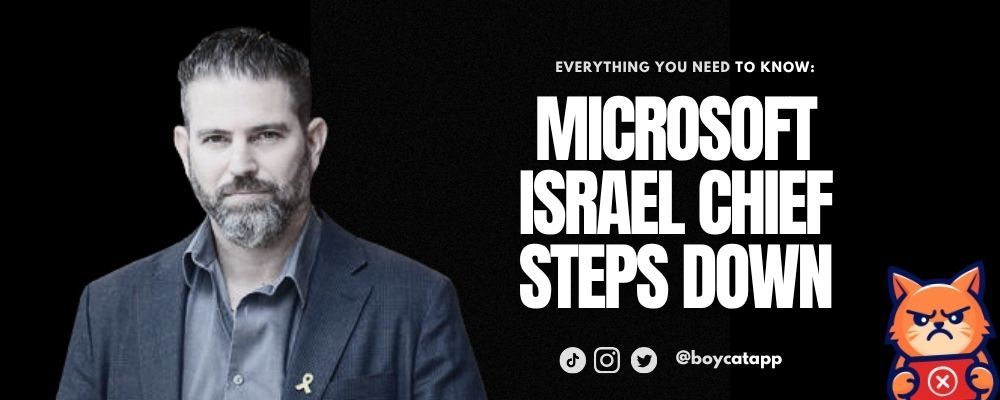
Microsoft says Unit 8200 violated its rules on mass surveillance. The deeper question is why Israeli military intelligence had access to civilian cloud infrastructure capable of surveilling Palestinians at scale.
Microsoft Israel’s general manager, Alon Haimovich, is stepping down after an internal inquiry into the company’s work with the Israeli military. The inquiry followed reporting that Israel’s Unit 8200 used Microsoft Azure to store and analyse intercepted Palestinian phone calls from Gaza and the occupied West Bank.
The reporting, first published by The Guardian with +972 Magazine and Local Call, found that Unit 8200 used Azure to hold a large archive of Palestinian communications. The system reportedly allowed Israeli intelligence officers to collect, replay, and analyse millions of phone calls every day.
Microsoft later concluded that Unit 8200 violated its terms of service, which prohibit using its technology to facilitate mass surveillance. The company then cut off the unit’s access to cloud services and AI products tied to the project.
The centre of the story is clear. Microsoft says it does not support mass surveillance. Its own systems were reportedly used by Israeli military intelligence to surveil Palestinians at scale. Now the head of Microsoft Israel is leaving.
This is not only a corporate leadership story. It is a violation involving a major technology company, a military intelligence agency, and the private communications of Palestinians living under occupation.
What happened
Microsoft commissioned the inquiry after reporting revealed that Unit 8200 had used Azure to store intercepted calls from Gaza and the occupied West Bank. The full findings have not been made public.
The Guardian reported that sources familiar with the situation said the inquiry led to Haimovich’s departure. Microsoft’s own announcement says Haimovich will step down on May 31, 2026, after four years as general manager of Microsoft Israel.
Israeli business newspaper Globes reported that the departure followed an investigation into alleged unethical use of Azure by Israel’s Ministry of Defense. Several managers in Microsoft Israel’s governance department also reportedly left their roles.
Documents reviewed by The Guardian suggest Haimovich helped develop the relationship between Microsoft Israel and Unit 8200 after a 2021 meeting between Microsoft CEO Satya Nadella and the unit’s then commander. The relationship reportedly included work on a segregated area inside Azure for sensitive intelligence material.
Once the infrastructure was in place, Unit 8200 reportedly began moving a large archive of Palestinian communications into Microsoft’s cloud.
For Microsoft, the issue may now be discussed in the language of ethics rules, terms of service, and internal oversight. For Palestinians, the issue is more direct: their private calls were reportedly intercepted, stored, and made searchable inside corporate infrastructure.
Microsoft’s position
Microsoft has said senior executives, including Nadella, were unaware that Unit 8200 was using Azure to store intercepted Palestinian communications. Brad Smith, Microsoft’s vice chair and president, said last year: “We do not provide technology to facilitate mass surveillance of civilians.”
Smith’s statement now sits beside Microsoft’s own conclusion that Unit 8200 violated its rules.
If Microsoft did not know, the failure is one of governance, due diligence, and human rights review. If local staff knew more than headquarters, the failure is also one of internal accountability. Either way, the outcome is the same: Israeli military intelligence reportedly used Microsoft infrastructure to help surveil Palestinians at scale.
A company of Microsoft’s size cannot treat ignorance as a complete defence. Azure is not a small product. It is core infrastructure used by governments, banks, hospitals, universities, companies, and public institutions around the world.
When infrastructure this powerful is sold to military intelligence agencies, the human rights review cannot happen after the harm is exposed by journalists.
What is Unit 8200?
Unit 8200 is Israel’s elite signals intelligence agency. It is often compared to the NSA in the United States or GCHQ in the United Kingdom, but its role is inseparable from Israel’s military control over Palestinians.
The unit handles signals intelligence, cyber operations, surveillance, and data analysis. In practice, it is part of the intelligence system used across Gaza and the occupied West Bank.
The context matters. A cloud contract with a military intelligence unit is not an ordinary enterprise software deal. Storage, analytics, AI tools, and computing power are not neutral when they are used to monitor an occupied population.
For Palestinians, surveillance is not an abstract privacy issue. It can shape who is stopped, searched, detained, targeted, denied movement, or placed under suspicion. A phone call can become intelligence. A contact list can become a network map. A private conversation can become a data point inside a military system.
Why Azure matters
Azure is Microsoft’s cloud computing platform. It gives customers access to storage, computing power, analytics tools, security services, and AI products without requiring them to build that infrastructure themselves.
The reported use of Azure makes this case serious because mass surveillance requires scale. It needs storage for large amounts of data. It needs computing power to process that data. It needs tools that allow operators to search, replay, organise, and analyse information quickly.
Cloud platforms are built for scale. The commercial value of the cloud is also the reason its misuse can become so dangerous.
According to The Guardian, Unit 8200 used Azure’s storage and computing capacity to operate a system that could collect, replay, and analyse millions of Palestinian phone calls every day. Middle East Eye reported that the system aimed to collect “a million calls per hour.”
The scale cuts through the corporate language.
This was not a narrow storage issue or a minor compliance failure. It was the reported use of civilian cloud infrastructure to support surveillance at a level that would have been harder to achieve without modern cloud systems.
Microsoft may not have designed the surveillance programme. Its infrastructure reportedly helped make the programme possible.
Why Palestinians are at the centre of this story
The story should not be reduced to Haimovich’s departure or Microsoft’s internal politics.
The people affected were Palestinians.
Their calls were reportedly intercepted. Their communications were reportedly stored. Their lives were placed inside a system controlled by Israeli military intelligence.
This happened in the context of occupation, siege, displacement, and mass death. Palestinians in Gaza and the West Bank already live under systems of control that decide whether they can move, work, study, receive medical care, visit family, or remain safe in their own homes.
Surveillance is part of that system. It is not passive. It helps classify people, map relationships, guide raids, enforce control, and make entire populations easier to govern.
Palestinian rights advocates have treated Microsoft’s role as complicity, not carelessness, because the harm sits inside a much larger system of occupation and control.
When a technology company sells infrastructure into a system of occupation, neutrality becomes harder to defend. Tools do not remain neutral when they are used by the powerful against the occupied.
The wider tech problem
Microsoft is not the only major technology company facing scrutiny over its ties to Israel’s military and government.
Google and Amazon have faced years of criticism over Project Nimbus, their cloud contract with the Israeli government. Other firms have been criticised for their roles in surveillance, policing, military systems, and state data infrastructure.
The Microsoft case shows how cloud platforms have become part of modern state power.
Cloud companies no longer just host websites or store office files. They provide infrastructure for intelligence archives, government databases, military analytics, AI systems, and real-time decision-making. Their tools can organise a company. They can also organise surveillance.
The burden on the industry is higher than it admits.
A company cannot market itself as responsible while relying on terms of service that only become meaningful after outside reporting exposes harm. If a military intelligence customer can use cloud infrastructure for mass surveillance, the review process is not serious enough.
The lesson is not that Microsoft needs better messaging. It needs enforceable limits.
Why pressure matters
The Palestinian-led Boycott, Divestment and Sanctions movement has long accused major technology companies of enabling Israeli apartheid, occupation, and military control.
Middle East Eye quoted the BDS movement describing Microsoft as “perhaps the most complicit tech company in Israel’s illegal apartheid regime and ongoing genocide against 2.3 million Palestinians in Gaza.”
Microsoft and Xbox remain targets of BDS pressure over the company’s contracts and technology relationships with the Israeli government and military, according to PC Gamer. Employee pressure has also grown, with Microsoft workers protesting the company’s relationship with Israel and shareholders demanding stronger human rights due diligence.
Game Developer also reported that workers in the gaming industry joined calls for Microsoft to end support for the Israeli regime, including an open letter from union members at Arkane Studios.
Public pressure matters because these systems are rarely visible on their own. They sit behind procurement language, enterprise sales teams, national security claims, and internal compliance processes. Public scrutiny is often the reason the details come out.
In this case, Azure access was reportedly terminated after investigative journalism, internal concern, worker organising, shareholder pressure, and public criticism forced the issue into view.
A personnel change is not accountability
Haimovich leaving Microsoft Israel may be significant. It is not enough.
A personnel change does not explain how the relationship with Unit 8200 was approved. It does not tell the public what Microsoft knew. It does not tell Palestinians how their communications were stored, processed, or used. It does not show whether similar arrangements exist with other military or intelligence agencies.
Microsoft has not released the full inquiry. Until it does, the public is left with fragments: an executive departure, reported governance failures, terminated cloud access, and statements that senior leaders were unaware.
Secrecy is not transparency.
If Microsoft wants to be taken seriously, it should answer basic questions. Who approved the Unit 8200 relationship? What did Microsoft Israel staff know? What did headquarters know? Which products were used? Where was the data stored? Were AI tools used to analyse Palestinian communications? What human rights review happened before the contract scaled?
These are not activist questions. They are accountability questions for a company whose infrastructure sits beneath major parts of global life.
“We did not know” cannot be the standard
A familiar pattern appears when technology companies are caught in the machinery of state power.
A company sells infrastructure to a government or military customer. The contract is described in neutral language. The product is framed as general-purpose. Internal ethics standards are cited as protection. Journalists later reveal how the tools were used. The company says senior leadership did not know. Someone leaves. The broader system stays intact.
This pattern should no longer satisfy anyone.
The more powerful a technology company becomes, the less convincing it is to treat downstream use as someone else’s problem.
Microsoft cannot control every action of every customer. But it can decide who gets access to sensitive infrastructure. It can decide whether military intelligence agencies require enhanced scrutiny. It can decide whether human rights risk should block a contract before the tools are deployed.
The violation here is not only that Microsoft’s terms were allegedly broken. The deeper failure is that those terms appear to have become the last line of defence when they should have been the minimum.
What happens next
Microsoft says Haimovich will step down on May 31 and that a successor will be announced later.
Haimovich’s departure may settle the leadership question. It does not settle the human rights question.
The next test is whether Microsoft releases more detail from its inquiry. If the company keeps the findings private, the public will have no way to judge whether its response matches the seriousness of the violation.
Regulators may also have questions. PC Gamer reported that Azure servers used to store surveillance data were based in Europe, raising possible legal and regulatory exposure.
The issue also reaches beyond Microsoft. Other technology companies should be pushed to disclose how they review contracts with military, police, and intelligence agencies, especially in contexts involving occupation, apartheid allegations, or mass civilian harm.
The public should not have to wait for another investigation to learn where surveillance infrastructure is being built.
The bottom line
Microsoft Israel’s chief is leaving after an inquiry into the company’s relationship with the Israeli military. The inquiry followed reporting that Unit 8200 used Azure to store and analyse intercepted Palestinian phone calls from Gaza and the occupied West Bank.
Microsoft says senior executives did not know. Microsoft says it does not provide technology for mass surveillance. Microsoft also concluded that Unit 8200 violated its terms of service and cut off access to services connected to the project.
All of those statements can be true, and still not be enough.
The central fact remains: Microsoft infrastructure was reportedly used by Israeli military intelligence to surveil Palestinians at scale.
For Palestinians, this is not a compliance story. It is part of the machinery of occupation becoming faster, cheaper, and more automated.
For the tech industry, it is a warning. Infrastructure is never neutral when it is used to control a population.
Stay safer online
Surveillance is not limited to governments. Everyday internet activity is tracked by platforms, advertisers, data brokers, internet providers, apps, and public WiFi networks.
A VPN will not stop military-grade surveillance. No privacy product should claim that. But a trustworthy VPN can reduce casual tracking, protect traffic on public networks, and make it harder for third parties to see where your browsing activity is going.
For readers looking for a privacy tool built with an ethical lens, Boycat recommends BuycatVPN.
Use it as one layer. Keep your devices updated. Use encrypted messaging when possible. Be careful with sensitive information. Privacy is not paranoia. It is a basic habit in a world where too many systems are built to watch.
Sources
The Guardian: “Head of Microsoft’s Israel branch to step down after inquiry into dealings with Israeli military.”
Middle East Eye: “Microsoft Israel chief leaves after inquiry into use of tech to spy on Palestinians.”
Microsoft Source EMEA: “Microsoft Israel GM Alon Haimovich announces departure.”
Globes: “Microsoft Israel chief leaves amid ethical controversy.”
Game Developer: “Microsoft Israel’s general manager set to leave amid alleged unethical use of Azure.”
PC Gamer: “Microsoft fires head of Israeli subsidiary and other managers over surveillance of Palestinians.”